 Reviews


 Proudly American


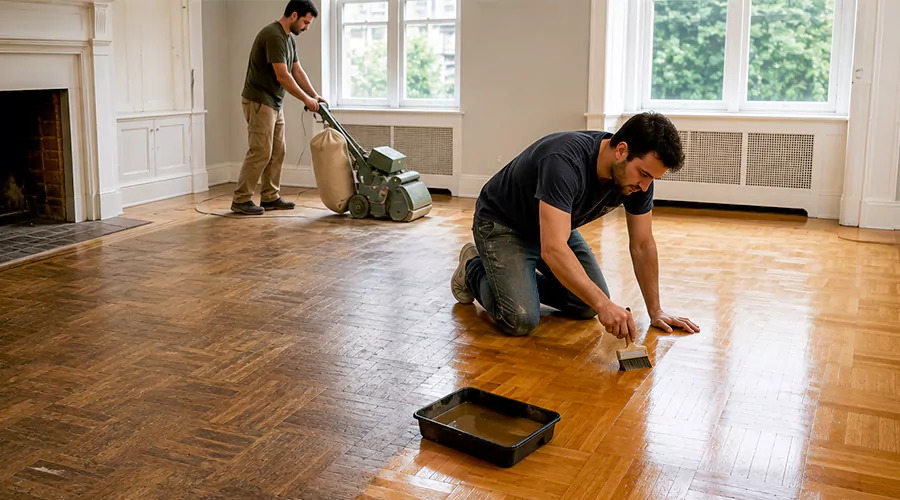
Yes, old parquet floors can often be restored, and many refinishing projects take about 2 to 7 days when the blocks remain structurally sound. Surface wear and isolated loose sections are often repairable. Severe rot or widespread missing blocks can make partial or full replacement more practical.
Parquet needs careful evaluation because its small wood blocks run in different grain directions.
What Types of Parquet Damage Can Be Restored?
Many old parquet floors have cosmetic wear rather than structural failure. A dull finish or shallow scratches can often be corrected without replacing the floor.
Common restorable conditions include:
- Worn finish
- Fine scratches
- Small gaps
- Isolated loose blocks
- Light staining
- Minor surface unevenness
- Old wax buildup
- Dull traffic areas
Parquet floor repair becomes more involved when moisture has loosened adhesive or several blocks have shifted.
When Is an Old Parquet Floor Too Damaged to Restore?
Replacement becomes more likely when the wood has lost structural integrity or there is too little material left for another sanding. Deep decay is different from an old finish that simply looks worn.
| Floor Condition | Likely Direction |
|---|---|
| Dull finish | Restore |
| Shallow scratches | Refinish |
| Small loose area | Repair then refinish |
| Isolated missing blocks | Patch if matching wood is available |
| Deep rot | Replace damaged sections |
| Widespread water damage | Evaluate for larger replacement |
| Very thin wear layer | Avoid aggressive sanding |
A careful inspection should happen before refinishing parquet floors because one weak section can become worse under sanding equipment.
How Is an Old Parquet Floor Restored?
Parquet flooring restoration usually starts with cleaning and repair before sanding begins. Loose blocks should be stabilized first so sanding equipment does not lift or break them.
A common sequence is:
- Clean the floor and identify damaged areas.
- Check for loose or hollow-sounding blocks.
- Repair isolated missing sections.
- Confirm the floor is dry.
- Sand with methods suited to parquet.
- Fill suitable small gaps when appropriate.
- Apply the chosen finish.
- Allow the finish to cure before normal use.
Wood floor restoration should preserve the pattern while removing only enough surface material to correct damage.
Why Does Parquet Require Special Sanding?
Parquet blocks run in several grain directions. Sanding aggressively in one direction can scratch some blocks across the grain while smoothing others. Sanding should remove only enough material to correct the damaged finish. Sanding and refinishing hardwood floors can take about two to seven days for many residential projects in 2026. Parquet may take longer when block repairs or detailed edge work are needed.
Can Loose Parquet Blocks Be Repaired?
Yes. Isolated loose blocks can often be reset when the wood itself remains usable. Old adhesive may need to be removed so the block can sit flat again.
A repair becomes harder when:
- Many blocks are loose.
- The subfloor is deteriorated.
- Moisture is still entering the floor.
- Blocks have warped permanently.
- Matching replacement wood is unavailable.
- Previous adhesive repairs are uneven.
Parquet floor repair should address the reason blocks came loose rather than simply gluing them back over a damp subfloor.
Can Water-Damaged Parquet Be Saved?
Some water-damaged parquet can be restored after the moisture source is stopped and the floor dries. Slight movement may improve as moisture levels return toward normal. More serious water damage can cause blocks to cup or release from the adhesive. Wait before sanding a recently wet floor. Wood can continue changing shape while moisture leaves. Sanding too early can create an uneven surface once the blocks stabilize. Restore water damaged wood floor areas only after the moisture condition has been checked.
How Much Does Parquet Restoration Cost?
Costs depend on whether the project needs simple refinishing or detailed block repairs. Traditional hardwood refinishing commonly runs around $3 to $8 per square foot in 2026. Detailed parquet repairs can push the project higher because individual pieces may need resetting or replacement.
| Work Needed | Cost Effect |
|---|---|
| Cleaning and light maintenance | Lowest |
| Standard sanding and finish | Moderate |
| Loose block repairs | Higher |
| Matching missing blocks | Higher |
| Subfloor repairs | Much higher |
| Extensive water damage | May approach replacement cost |
Wood floor refinishing is usually more economical than replacement when the existing parquet remains stable.
What Can You Check Yourself Before Restoration?
A simple stability check can reveal whether the problem is mostly cosmetic. Clean the floor first so dirt does not hide cracks or loose pieces.
Check these areas:
- Walk slowly and listen for movement.
- Tap blocks lightly for hollow sounds.
- Look for raised corners.
- Check for dark water stains.
- Inspect transitions for missing blocks.
- Look for previous deep sanding.
- Compare damaged areas with less-used sections.
- Check for active moisture before refinishing.
Do not pry up a loose block simply to see what is underneath. Older parquet can be brittle and matching replacements may be difficult to find.
When Should You Call a Professional?
Professional assessment is useful when the parquet is old enough that its remaining thickness is uncertain or when many blocks are loose.
Consider professional help when:
- Large areas are loose.
- The subfloor may be damaged.
- Water damage affected several sections.
- The floor has been sanded many times.
- Matching blocks are difficult to source.
- Historic patterns should be preserved.
- Several previous repairs have failed.
Hardwood floor restoration can sometimes save a floor that appears badly worn when most of the damage is still confined to the finish.
How Can You Protect Restored Parquet?
A restored parquet floor lasts longer when grit and standing water are kept off the finish.
Useful habits include:
- Dust or vacuum regularly.
- Wipe spills immediately.
- Avoid steam mops.
- Use a finish-compatible cleaner.
- Keep indoor humidity around 30 to 50 percent.
- Use protective pads under furniture.
A maintenance coat may be useful before the finish wears completely through to bare wood.
Conclusion
Old parquet floors can often be restored when the blocks remain stable and there is enough wood for refinishing. Surface wear or isolated loose pieces are usually better candidates than widespread rot or severe water damage. Repair unstable sections before sanding and confirm that the floor is dry. If the parquet has been sanded repeatedly or contains a detailed historic pattern, professional assessment can reduce the risk of permanent damage.
Frequently Asked Questions
Is old parquet flooring worth restoring?
Often, yes. Original parquet can remain attractive for decades when the blocks are stable and the surface can still be refinished.
Can loose parquet blocks be glued back down?
Many isolated blocks can be reset. The old adhesive and moisture condition should be checked before the repair.
Can badly scratched parquet be refinished?
Often. The remaining wood thickness must be sufficient for sanding without damaging the blocks.
How long does parquet refinishing take?
Many projects take several days. Repairs or detailed patterns can extend the schedule beyond standard refinishing.
Can parquet be restored after water damage?
Sometimes. The floor should dry and stabilize before sanding or deciding which blocks need replacement.
How often can parquet be sanded?
There is no fixed number. The answer depends on block thickness and how much wood previous sanding removed.